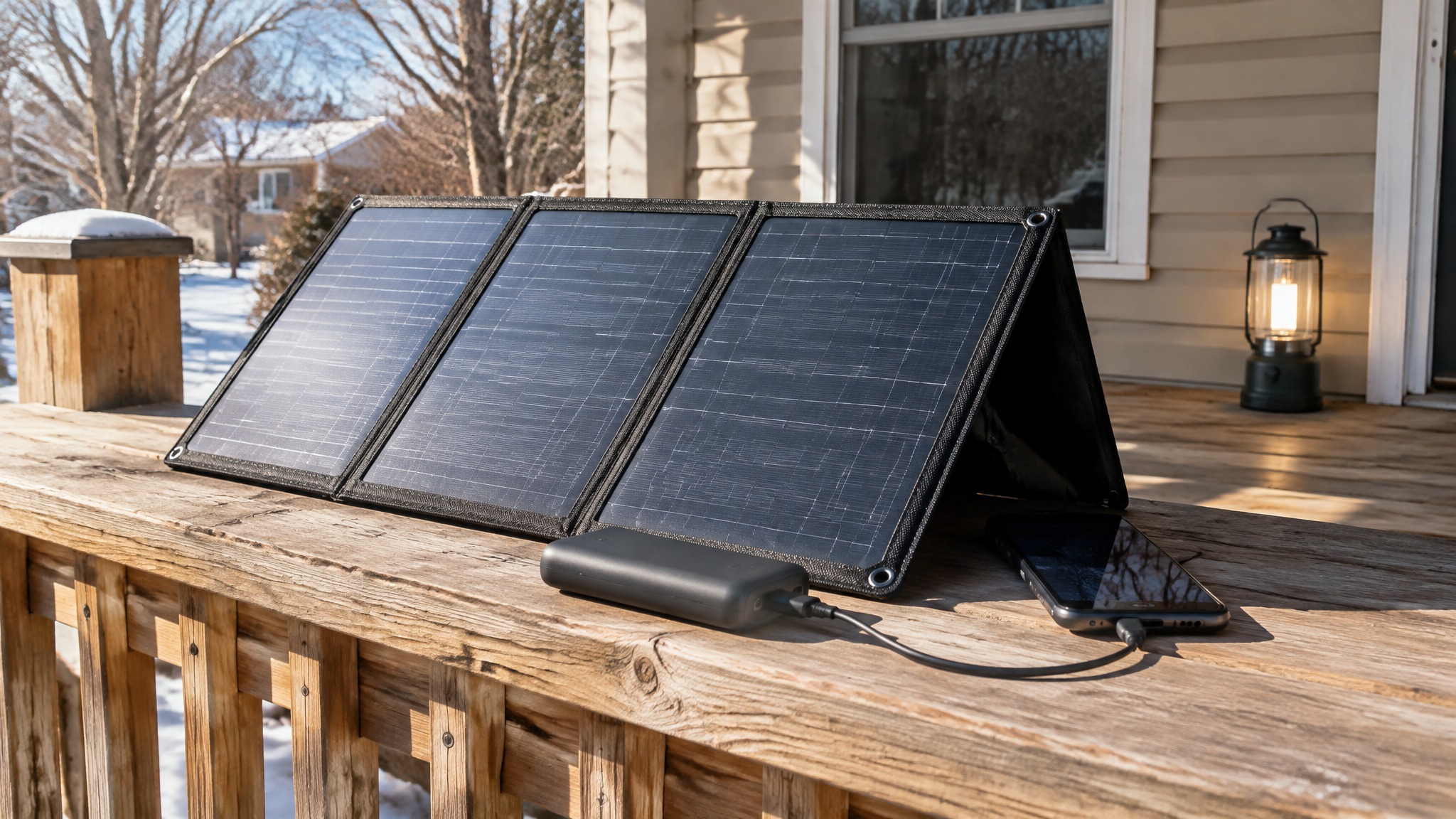
How Long Does a Solar Charger Take to Charge a Phone?
Disclosure: this post contains affiliate links. If you buy through them, ReneEnergy may earn a commission at no extra cost to you. As an Amazon Associate I earn from qualifying purchases.
Last updated November 21, 2026 · By Alex, ReneEnergy
How long does a solar charger take to charge a phone? A 21–28 W folding solar charger in clear, direct sun typically takes about 1 to 2 hours to bring a phone with a 4,000 mAh battery (such as a Samsung Galaxy S25) from 20% to full. Under haze or thin cloud, plan on 3 to 4 hours; under heavy overcast, 7 hours or more, or no useful charge at all.
Those numbers come from our own worked calculation below, built on the phone maker's battery rating, the panel makers' port limits and independent field readings. The rest of this guide shows how to estimate the time for your own phone and panel, and why the watt rating printed on the panel is not what reaches your phone.
Why doesn't a 21 W solar charger deliver 21 W to my phone?
Because the rating is measured at Standard Test Conditions, which real sunlight rarely matches. Penn State's solar engineering course notes that PV ratings are set at an irradiance of 1,000 W/m², an AM1.5 spectrum and a cell temperature of 25 °C, and that output varies with temperature and irradiance (Penn State AE 868). BigBlue's own product FAQ says the same in plain words: actual output is "less than the nominal / rated power," reduced by heat, weather, season and location (BigBlue SolarPowa 28, 2026).
The USB ports add a second cap. Most small folding chargers output only 5 volts. Anker lists its 21 W PowerPort Solar at up to 2.4 A per port and 3 A overall, which is 15 W at 5 V (Anker PowerPort Solar specifications). BigBlue lists 5 V / 3 A per port and 5 V / 4.8 A total, about 15 W and 24 W.
Field readings show the gap. In OutdoorGearLab's August 2026 test, the BigBlue 28 W read 1.5 A lying flat on the ground and 2.1 A once tilted toward the sun (OutdoorGearLab, 2026). At USB's 5 V that is about 7.5 W and 10.5 W: roughly a quarter to a third of the 28 W label.
How long does a solar charger take to charge a phone in different weather?
In our worked example, the same phone needs about 80 minutes with a well-aimed panel in clear sun and about 7 hours under overcast. The table uses a Galaxy S25, which Samsung rates at 4,000 mAh typical and 3,885 mAh rated capacity (Samsung Galaxy S25 specs).
Condition | Power reaching the phone (W) | Time, 20% to 100% (hours) | Time (minutes) |
Port maximum, 5 V × 3 A (best case, rarely sustained) | 15.0 | 0.9 | 56 |
Clear sky, panel tilted at the sun (5 V × 2.1 A, measured) | 10.5 | 1.3 | 80 |
Clear sky, panel flat on the ground (5 V × 1.5 A, measured) | 7.5 | 1.9 | 113 |
Haze or thin cloud (assumed) | 4.0 | 3.5 | 211 |
Heavy overcast (assumed) | 2.0 | 7.0 | 422 |
How we calculated it: 3,885 mAh × 3.85 V (an assumed typical lithium-ion nominal voltage) ≈ 14.96 Wh. Charging 80% of that, with an assumed 85% charging efficiency inside the phone, needs about 14.1 Wh from the panel. Time = 14.1 Wh ÷ watts delivered. The measured rows use OutdoorGearLab's ammeter readings; the cloudy rows are our assumptions. Illustrative only, not test data for any specific product.
Is it faster to charge a power bank first?
Usually yes for convenience, though not for raw speed. A 10,000 mAh power bank at 3.7 V holds 37 Wh. In our example it takes about 4.1 hours at 10.5 W or 5.8 hours at 7.5 W to fill (assuming 85% charging efficiency), and then holds about 2.1 full charges of a Galaxy S25 (assuming 85% efficiency on the way out).
The advantage is reliability. Many phones and power banks stop charging and restart when a cloud passes. OutdoorGearLab's 2020 test of the Anker 21 W found it "resumed charging after about five minutes" after shading (OutdoorGearLab, 2020). A power bank soaks up the sun all day while your phone stays in your pocket, out of the heat.
What makes solar phone charging slower or faster?
Sun angle, season, location and shade matter most. The U.S. Energy Information Administration notes that sunlight is strongest when the sun is highest, that lower latitudes and arid climates get more of it, and that seasonal swings grow farther from the equator (EIA, Energy Explained, 2026). In practice:
Aim the panel. In the 2026 BigBlue readings, tilting toward the sun raised current by 40% (1.5 A to 2.1 A).
Charge around midday. Morning and late-afternoon sun gives a fraction of the noon output.
Keep the phone cool and in shade. Phones slow or pause charging when hot; run the cable so the phone sits under the panel.
Avoid partial shade. A branch shadow across one panel section can cut output far more than its size suggests.
Don't expect fast charging. USB Power Delivery can carry up to 240 W over USB-C (USB-IF, USB PD 3.1, 2021), but small 5 V solar ports don't negotiate it, so phones charge at standard USB rates.
How do I choose a solar charger for phone charging?
Pick by port output and panel size first, brand second. Our checklist, based on published specs:
Panel rating of 20–30 W for one phone plus a power bank; smaller panels (5–10 W) are often too slow to be useful.
Port limits: look for at least 5 V / 2.4 A per port and a stated total output.
USB-C ports if your cables are USB-C; check whether they are 5 V only or support PD.
Auto-restart after a cloud passes, so charging doesn't stall.
Weight and folded size for hiking; check the stated weather resistance and warranty.
Spec (published by maker) | Anker PowerPort Solar 21 W | BigBlue SolarPowa 28 W |
Rated panel power (W) | 21 | 28 |
Ports | 2 × USB-A | 1 × USB-A, 2 × USB-C |
Max per port (V / A) | 5 / 2.4 | 5 / 3 |
Max total (V / A) | 5 / 3 | 5 / 4.8 |
Stated cell efficiency (%) | 21.5–23.5 | up to 25.4 |
Folded size (cm) | 28.2 × 16.0 | 28.1 × 16.0 × 3.5 |
Weight (kg) | not stated by Anker | 0.68 |
Warranty | 18 months | not stated on product page |
Picks based on published specs (we have not tested these products):
Anker 21W 2-Port PowerPort Solar charger: a long-running, simple 5 V panel for one or two USB-A devices.
BigBlue 28W solar charger (2 × USB-C + USB-A): more total output (24 W) and USB-C ports for charging a phone and a power bank together.
Assumptions and limits
Times are illustrative assumptions, not a test of any product. We assumed a 3.85 V nominal battery voltage, 85% charging efficiency and the cloudy-weather power levels shown. Real results depend on your phone's charging behavior, cable, temperature, latitude, season and how often the panel is re-aimed. Phone battery ratings and product specs come from the makers' pages as read on November 21, 2026.
FAQ
Can a solar charger charge a phone on a cloudy day?
Sometimes, but slowly. Under heavy overcast our example drops to about 2 W, so a 20%-to-full charge would take about 7 hours, and some chargers stop and restart repeatedly. Charging a power bank whenever the sun breaks through works better.
Can I charge my phone directly from the solar panel?
Yes. Plug the phone into the panel's USB port. Keep the phone shaded, because heat slows charging, and consider a power bank in between so interruptions don't matter.
How many phone charges can a solar charger give in one day?
As an illustration, about 4 hours of good sun at 10 W gives roughly 40 Wh, or about two to three 20%-to-full charges of a 4,000 mAh phone (14.1 Wh each). Short winter days and clouds can cut that to less than one.
Will a solar charger fast-charge my iPhone or Android?
Usually not. Most small folding panels output 5 V only, so they don't use USB Power Delivery fast charging. Expect standard charging speeds at best.
Related reading
Thinking about going solar?
A folding charger is a small first step. If you're curious what solar could do for your whole home, start with a no-obligation estimate.
Sources
Fact-checked November 21, 2026.