
What Is a Hydrogen Hub? A Beginner's Guide

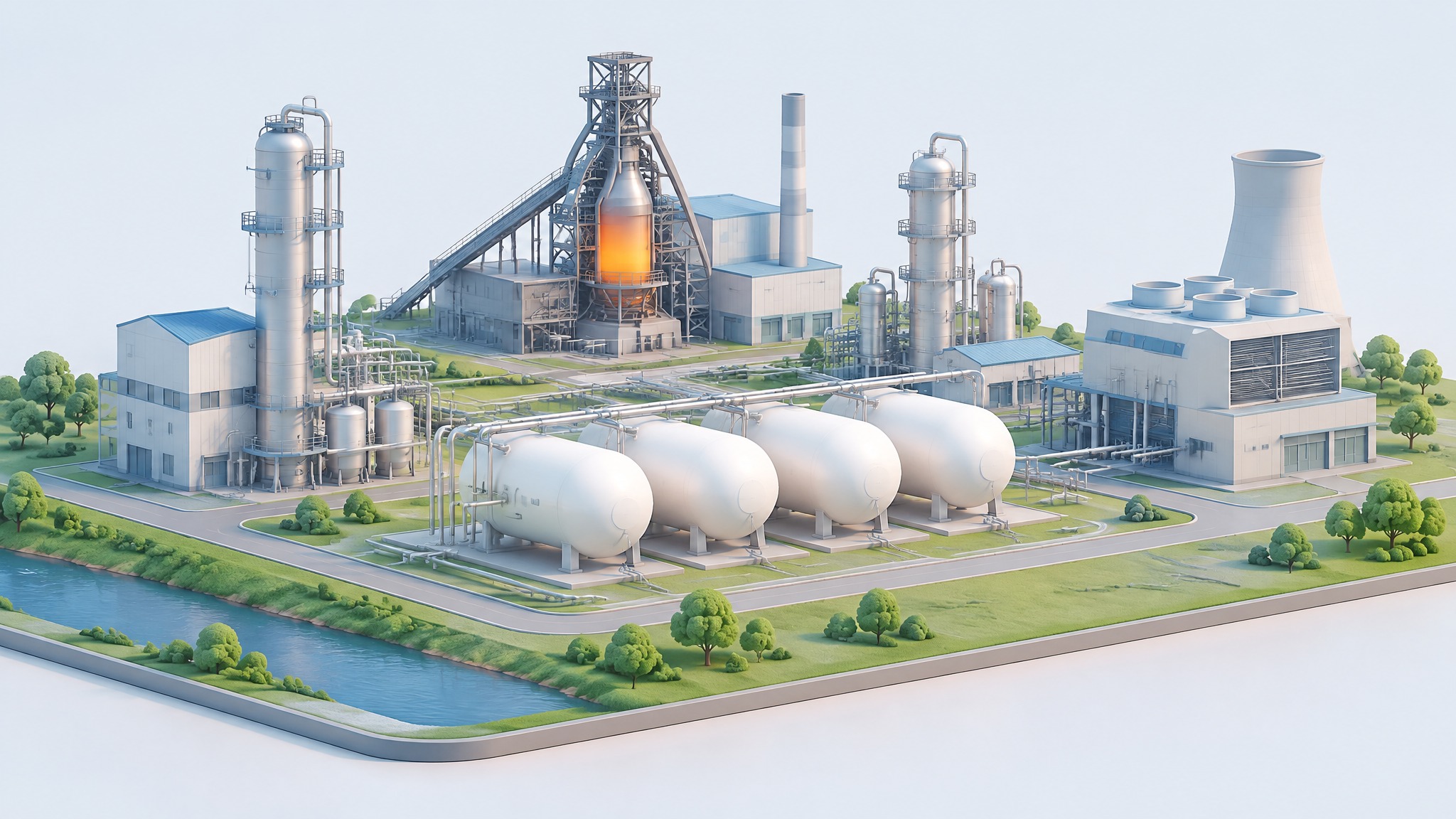
What is a hydrogen hub? A hydrogen hub is a cluster of hydrogen producers, users and the pipes, storage and trucks that connect them, built in one region so that supply and demand grow together instead of waiting for each other. Governments in the United States and Europe have both used the idea, calling them "hydrogen hubs" and "Hydrogen Valleys", to get the first large clean hydrogen projects built.
This guide explains how a hub works, why planners like the idea, how hub projects get from idea to operation, and where the approach runs into trouble.
What is a hydrogen hub, in plain English?
The US Department of Energy (DOE) describes its hubs as "networks of hydrogen producers, consumers, and local connective infrastructure." The European Clean Hydrogen Partnership says its Hydrogen Valleys "bring together clean hydrogen production, storage of hydrogen and distribution to end-uses" within a region.
Think of a hub as three layers sitting close together:
Supply: plants that make hydrogen, for example electrolyzers running on wind, solar or nuclear power, or gas-based plants that capture their carbon.
Connections: pipelines, compressors, storage tanks or underground storage, and truck loading points.
Demand: the users who pay for the hydrogen, such as refineries, fertilizer plants, steelworks, ports, bus or truck fleets and power plants.
The point of putting them together is to share the expensive middle layer. One pipeline or storage site serving several producers and several buyers costs each of them less than a private line each, and a buyer is more willing to sign up when there is more than one supplier nearby.
Why build hubs instead of single projects?
Clean hydrogen has a chicken-and-egg problem. Producers will not build without buyers, and buyers will not switch equipment without a reliable supply. The International Energy Agency's Global Hydrogen Review 2026 calls demand "the crucial missing piece for the sector to take off." It reports that new offtake (purchase) agreements in 2025 covered around 1.7 million tonnes a year, but only around 20% of those volumes were backed by firm contractual commitments.
To put that in scale, the same review says global hydrogen demand passed 100 million tonnes in 2025, while low-emissions hydrogen production reached almost 1 million tonnes. Nearly all hydrogen used today is still made from fossil fuels without capturing the carbon. Hubs try to close that gap one region at a time, by lining up a group of buyers and sellers who can commit together.
Hydrogen hubs in the United States
The 2021 Bipartisan Infrastructure Law created an $8 billion hydrogen hub program. DOE's Office of Clean Energy Demonstrations offered $7 billion of it through a funding competition for six to ten regional clean hydrogen hubs, plus up to $1 billion for a demand-side support initiative. DOE selected seven hubs in October 2023.
The program has since been cut back. On October 1, 2025, DOE announced it was terminating 321 financial awards supporting 223 projects, worth about $7.56 billion, across several offices including Clean Energy Demonstrations. A letter from California Senator Alex Padilla dated the next day protested the cancellation of California's hub, ARCHES. Where the remaining hubs stand can change with each budget, so check DOE's own pages before relying on any one hub's status.
Hydrogen Valleys in Europe
The European Union uses the term Hydrogen Valley. According to the Clean Hydrogen Partnership, the European Commission aims for at least 50 Hydrogen Valleys under construction or operating by 2030. The Partnership has supported 27 valley projects across 23 countries, with €338 million of its own funding.
The Partnership sorts valleys by size: large-scale valleys produce and use more than 4,000 tonnes of hydrogen a year, and small-scale ones more than 500 tonnes. Its examples include HEAVENN in the northern Netherlands (large) and GreenHysland on Mallorca (small).
How big is a hub? An illustrative calculation
Here is a simple way to picture those size classes. DOE lists today's PEM electrolyzer systems at about 55 kWh of electricity per kilogram of hydrogen (its 2022 status figure). If we assume an electrolyzer runs at an average of half its full power over the year:
Electrolyzer size | Average load | Hydrogen per year | Hydrogen per day |
10 MW | 50% | about 800 tonnes | about 2.2 tonnes |
100 MW | 50% | about 8,000 tonnes | about 22 tonnes |
The math: 10,000 kW × 8,760 hours × 0.5 ÷ 55 kWh/kg ≈ 796,000 kg a year. These are illustrative numbers, not figures for any real project. On these assumptions, a single 10 MW unit clears the small-valley bar, while a large valley needs something closer to 100 MW of electrolysis, or several plants, plus enough buyers to take all of it.
How a hydrogen hub project gets built
Every hub is different, but most follow the same broad steps:
Find the anchor demand. Start with existing hydrogen users or industries that could switch, such as a refinery, ammonia plant or port.
Screen sites. Check power supply, water, land, grid connection and room for pipelines or storage.
Form the group. Producers, buyers, utilities, local government and often universities agree to work together.
Secure buyers and funding. Move from letters of interest to firm purchase contracts, and apply for public grants or incentives where they exist.
Permits and engineering. Environmental reviews, safety studies and detailed design.
Final investment decision (FID). Lenders and owners commit the money to build.
Build and operate, often in phases, adding producers and users over time.
Most hub projects that stall do so at step 4. A grant can cover part of the cost to build, but it cannot replace a buyer who has committed to purchase the hydrogen for years.
What drives the cost of a hub?
Without getting into dollar figures, a few things decide whether hub hydrogen is affordable:
Electricity price and running hours. For electrolysis, power is usually the biggest cost, and an electrolyzer that sits idle still has to be paid for.
Equipment cost and lifetime. Electrolyzers, compressors and storage are capital-heavy.
Cost of borrowing. Riskier projects pay more for finance, which raises the cost of every kilogram.
Moving and storing hydrogen. Shared pipelines and storage are where hubs try to save money.
Policy support. Grants, tax credits and contracts for difference can change the picture, and they can also be withdrawn, as the US example shows.
If you want to see how these inputs combine into a cost per kilogram, H2Hub's explainer What Is LCOH? A Practical Hydrogen Cost Example walks through it, and its hydrogen offtake agreement checklist covers what makes a buyer contract solid.
Where hubs make sense, and where they don't
Hubs work best where hydrogen is already used or hard to replace: refineries, fertilizer and chemical plants, and possibly steelmaking and some heavy transport around ports. Those users are concentrated, which suits shared pipelines.
Hubs are a weaker fit where electricity can do the job directly and more efficiently, such as most passenger cars and home heating, because turning power into hydrogen and back loses a large share of the energy. A hub also cannot fix weak demand on its own. If the anchor buyers never sign firm contracts, shared infrastructure ends up serving no one, and public money committed to it can be withdrawn.
Screening a real hydrogen project?
If you are weighing a project inside or near a hub, H2Hub lets you set up a project without an account or card, and the first full project report is free per account. Start a free project screen in H2Hub.
Related reading
Sources
US Department of Energy, Office of Clean Energy Demonstrations, "Regional Clean Hydrogen Hubs" (checked Nov 13, 2026): energy.gov/oced/regional-clean-hydrogen-hubs-0
US Department of Energy, "Energy Department Announces Termination of 223 Projects, Saving Over $7.5 Billion" (Oct 1, 2025): energy.gov
Office of US Senator Alex Padilla, letter on ARCHES and DOE cancellations (Oct 2, 2025): padilla.senate.gov
Clean Hydrogen Partnership (EU), "Hydrogen Valleys" (checked Nov 13, 2026): clean-hydrogen.europa.eu
International Energy Agency, Global Hydrogen Review 2026, Executive summary: iea.org
US Department of Energy, Hydrogen and Fuel Cell Technologies Office, "Technical Targets for Proton Exchange Membrane Electrolysis" (last modified May 29, 2026): energy.gov
Fact-checked November 13, 2026.

Comments