
Do Solar Chargers Work on Cloudy Days? What to Expect
Disclosure: this post contains affiliate links. If you buy through them, ReneEnergy may earn a commission at no extra cost to you. As an Amazon Associate I earn from qualifying purchases.
Last updated November 22, 2026 · By Alex, ReneEnergy
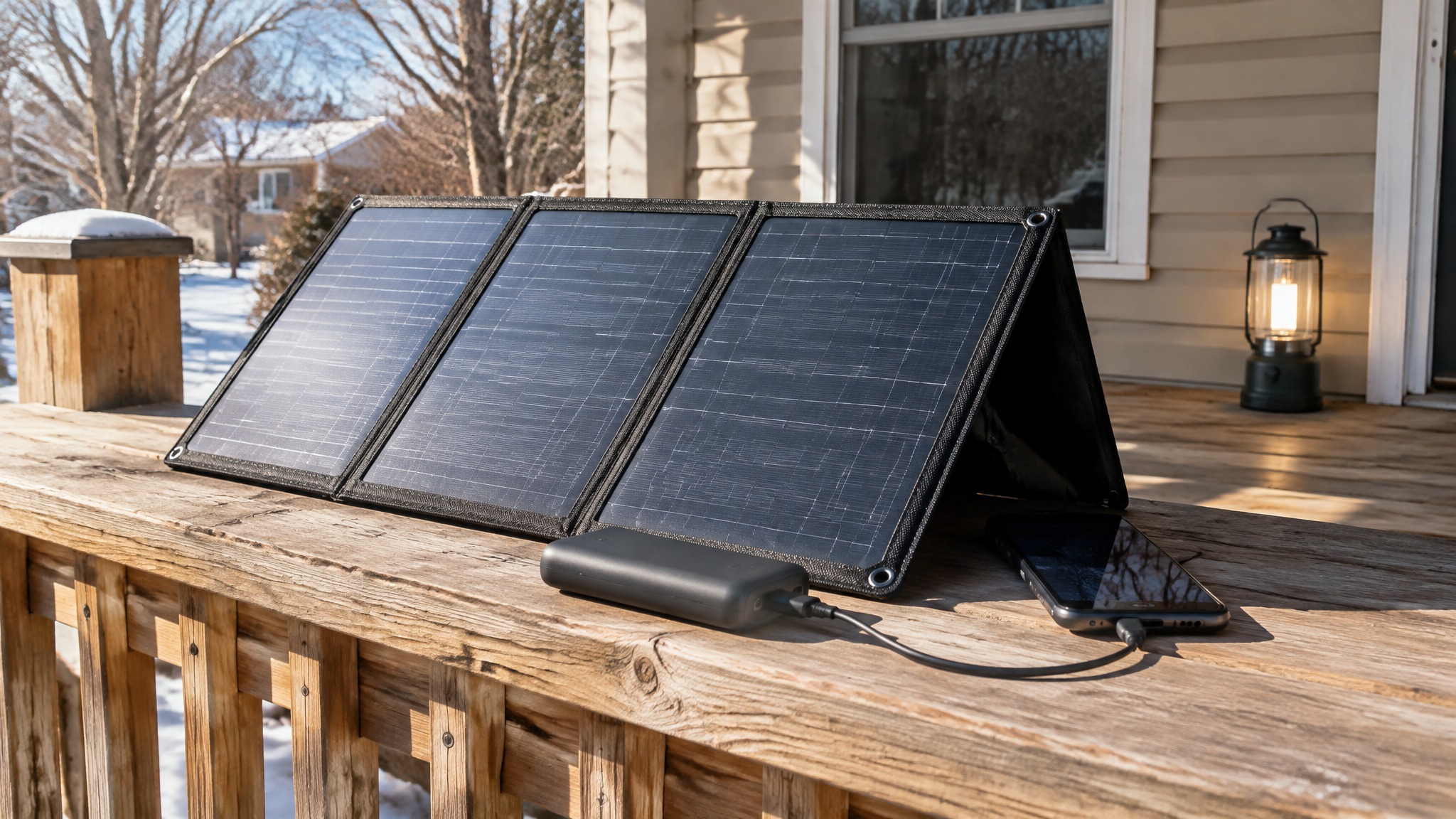
Do solar chargers work on cloudy days? Yes, but slowly. A portable solar charger still makes power from diffuse light under cloud, yet heavy overcast can cut the sunlight reaching it by as much as 90%. In our worked example, a 21 W folding solar charger that refills a phone in about 1 hour in full sun needs roughly 7 to 8 hours under heavy overcast.
That gap is the whole story. Below we show where the numbers come from, why a phone sometimes stops charging when a cloud passes, and which charger specs help most in poor weather.
How much power does a solar charger lose on a cloudy day?
A solar charger can lose most of its output under thick cloud: Penn State's EME 812 solar course notes that the solar flux reaching the ground is reduced by about 30% on a sunny day but "by as much as 90% on a cloudy day," compared with the radiation arriving at the top of the atmosphere (Penn State EME 812). The U.S. Department of Energy's Solar Radiation Basics page (updated July 2026) adds that thick clouds can block 100% of direct-beam sunlight, while some light still arrives scattered as diffuse radiation (DOE).
Diffuse light is why a panel never drops to exactly zero in daytime. It is also why output under cloud is so variable: thin, bright cloud can still give a usable trickle, while a dark storm sky gives very little.
How long does a solar charger take to charge a phone on a cloudy day?
Under heavy overcast, expect a phone charge to take several times longer than in full sun, often most of a day. Solar panels are rated at standard test conditions of 1,000 W/m² of sunlight and a 25 °C cell temperature (Penn State AE 868), so a "21 W" charger only delivers close to 21 W in strong, direct sun.
Our worked example uses a 21 W and a 28 W charger, a 15 Wh phone battery and the assumptions listed under the table. The arithmetic was run in Python.
Sky condition (assumed sunlight, W/m²) | 21 W charger: usable output (W) | 21 W charger: time to charge 15 Wh phone (h) | 28 W charger: usable output (W) | 28 W charger: time to charge 15 Wh phone (h) |
Full sun (1,000) | 15.8 | 1.1 | 21.0 | 0.8 |
Thin cloud or haze (500) | 7.9 | 2.2 | 10.5 | 1.7 |
Heavy overcast (150) | 2.4 | 7.5 | 3.2 | 5.6 |
Illustrative assumptions, not test results: output scales with sunlight; 75% of the panel rating reaches the USB port (heat, angle and conversion losses); 85% charging efficiency into the phone; 15 Wh phone battery. Real sunlight under cloud changes minute to minute, and at very low light some chargers stop delivering usable USB power at all.
Two things stand out. Doubling panel size does not fix a dark day, and a bigger panel helps most in the "thin cloud" middle band, where a small charger drops below what a phone wants.
Why does my phone stop charging when a cloud passes over?
Your phone stops because the panel's voltage and current sag below what the phone accepts, and many phones then wait before trying again. In OutdoorGearLab's 2020 review of the Anker PowerPort Solar 21W, the panel "resumed charging after about five minutes" after being shaded and uncovered (OutdoorGearLab, 2020). On a day of passing clouds, those pauses add up.
The practical fix is a buffer: charge a power bank from the panel, then charge the phone from the power bank. A power bank accepts uneven input more patiently, and your phone gets a steady charge whenever you need it. If your solar power bank seems to ignore the sun, our post on why a solar power bank doesn't charge with solar explains why small built-in panels are so slow.
How can you get more from a solar charger on a cloudy day?
Point the panel at the brightest part of the sky, keep it cool and fully unshaded, and charge a power bank rather than the phone directly. Anker rates the PowerPort Solar's array at 21.5–23.5% efficiency (Anker), so roughly three-quarters of the light that hits even a good panel is not turned into electricity; every bit of extra light you catch matters.
Aim at the bright patch. Under cloud, the brightest part of the sky is usually where the sun is hidden. Tilt the panel toward it and re-aim every hour or two.
Avoid partial shade. A strap, branch or backpack shadow across one cell can drop output far more than its size suggests.
Charge a power bank, not the phone. It rides through dips without the phone's restart delay.
Keep the phone out of the sun. A hot phone slows its own charging; put it in shade on a longer cable.
Charge when you can. Top up on the clear spells and save heavy use for later.
Which solar charger specs matter most for cloudy weather?
For cloudy weather, panel watts and a built-in current readout matter more than port count. Using our table above, moving from 21 W to 28 W cut the heavy-overcast phone charge from about 7.5 to 5.6 hours; a larger panel is the only spec that directly raises output in weak light.
Panel rating (W): 20–30 W suits phones and power banks; under 10 W is very slow even in sun.
Output display or ammeter: showing current lets you aim the panel for the best reading instead of guessing.
Ports: USB-A at 5 V is the norm on small chargers. USB-C helps compatibility, but on a cloudy day the panel, not the port, sets the limit.
Weather resistance: a panel used in drizzle needs a rated or clearly specified weather resistance; check the listing and keep connectors dry.
Folded size and weight: a bigger panel is only useful if you will actually carry and deploy it.
These picks are based on published specs, not our own testing:
Charger | Rated panel power (W) | Ports | Max output (published) | Why it fits cloudy days |
21 | 2 × USB-A | 2.4 A per port, 3 A combined (Anker) | Compact folded size of about 28.2 × 16.0 cm; good for topping up a power bank | |
28 | USB-A and USB-C (per listing) | 5 V / 4 A combined (per listing) | More panel area plus an ammeter to find the best angle under cloud |
For camping-specific choices, see our guide to solar chargers for camping and which specs matter.
FAQ
Do solar chargers work in the rain?
They produce a little power from diffuse light during rain, but output is usually very low because rain clouds are thick. Only use a panel in rain if its specs say it is weather resistant, and keep the USB connectors and the phone dry.
Do solar chargers work through a window?
They work, but more slowly, because glass reflects and absorbs part of the light and windows rarely face the sun all day. Outdoors in direct sun is always faster.
Can a solar charger charge a phone in winter?
Yes. Cold itself does not stop a panel; short days, a low sun and more cloud do. Expect fewer useful charging hours and aim the panel steeply toward the sun.
Is a bigger solar charger worth it for cloudy places?
Often yes, if you can carry it. In our example a 28 W panel charged a phone about 25% faster than a 21 W panel under heavy overcast, but neither makes a dark day fast.
Assumptions and limits
The charge-time table is a simplified calculation that assumes output scales linearly with sunlight; real panels, cables and phones behave less neatly, and very low light can stop USB output entirely. Product details come from manufacturer and retailer listings checked on November 22, 2026, and may change. This is general information, not a product test or electrical advice.
Related reading
Thinking about going solar?
If a small charger has you curious about solar power for your whole home, start with a personalized estimate based on your roof and usage.
Sources
Penn State EME 812: Available Solar Radiation and How It Is Measured (accessed Nov 22, 2026)
U.S. Department of Energy: Solar Radiation Basics (updated July 21, 2026)
Penn State AE 868: Interpreting PV Manufacturer Datasheet (accessed Nov 22, 2026)
OutdoorGearLab: Anker PowerPort 21W review (May 2, 2020)
Anker: PowerPort Solar 21W product page (accessed Nov 22, 2026)
Retail listing: BigBlue Portable Solar Charger 28W (ASIN B071G4CQSR) (accessed Nov 22, 2026)
Fact-checked November 22, 2026.

Comments