
DC to DC Charger for RV: Do You Need One and What Size?
Disclosure: this post contains affiliate links. If you buy through them, ReneEnergy may earn a commission at no extra cost to you. As an Amazon Associate I earn from qualifying purchases.

You need a DC to DC charger for your RV if you charge a lithium (LiFePO4) house battery from the engine's alternator, or if your tow vehicle or van has a "smart" alternator that changes its voltage on its own. Size it so the charger draws well under half of your alternator's rated amps: for most vans and campers that means a 20 to 40 A unit.
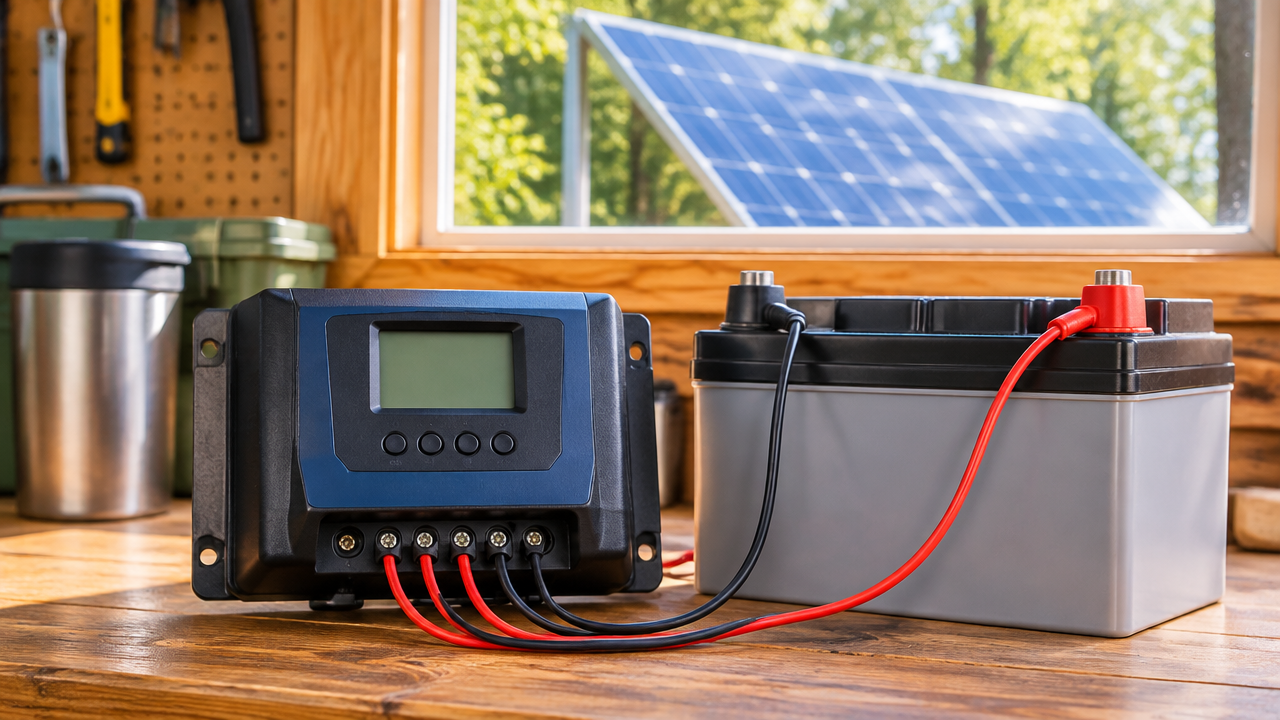
Quick answer: a DC to DC charger sits between the starter battery and the house battery. It takes whatever the alternator gives it, then delivers a controlled, multi-stage charge at the voltage your house battery wants, and it limits how much current the house bank can pull. That protects the alternator, makes up for voltage lost in long cables and keeps charging working with smart alternators. Solar still does the daily work; the DC to DC charger adds a reliable top-up every time you drive.
What a DC to DC charger for an RV actually does
Without one, the house battery is wired more or less straight to the alternator circuit, so it gets whatever voltage the vehicle happens to produce. A DC to DC charger breaks that direct link. Victron's manual for its Orion-Tr Smart isolated chargers puts it plainly: "Especially in the case of vehicles with a smart alternator, controlled charging is indispensable," and "Controlled charging will also protect the alternator in lithium systems."
It also decides when to charge. Victron's chargers detect a running engine from the alternator voltage. With the smart-alternator setting on a 12 V input, the default start voltage is 14 V and the shutdown voltage is 13.1 V, so the charger does not drain the starter battery when the engine is off.
Three reasons RVs need one
1. Lithium batteries can overload the alternator
Battle Born, a LiFePO4 battery maker, warns that a lithium bank "can demand a sustained high current" and that most alternators "will overheat when operating at this maximum load for long periods." Its rule of thumb: an alternator can handle about half its rated amps continuously, so a 180 A alternator is good for roughly 90 A all day. A DC to DC charger caps the draw, for example at 30 or 40 A, instead of letting the house bank pull whatever it can.
2. Smart alternators drop their voltage
Many newer vehicles adjust alternator output for fuel economy and emissions, and Battle Born notes these systems "may reduce voltage or output unexpectedly." A house battery wired directly then sits partly charged. A charger rated for smart alternators keeps working at lower input voltages; Renogy, for example, lists a 12 to 16 V input range in smart-alternator (Euro 6) mode on its 40 A unit.
3. Long cable runs lose voltage
The house battery in a trailer or the back of a van can be many feet from the alternator. Battle Born points out that long runs, thin cable and weak grounds all cause voltage drop and heat, and that 12 V systems have little margin to lose. Because the charger sets its own output voltage, it makes up for what the cable loses.
Worked example: what size DC to DC charger do you need?
The setup below is illustrative, not a measurement of any vehicle. We assumed a 12 V LiFePO4 house bank that used 100 Ah overnight, a 2-hour drive, the alternator holding about 13.8 V at the charger input and the charger delivering 14.4 V to the battery during bulk charging. Efficiencies are the makers' published figures (87% for Victron's Orion-Tr Smart isolated models, 94% for Renogy's 40 A unit). Real charging slows as the battery nears full, so treat the Ah figures as a best case.
Charger size | Output to battery (W) | Approx. draw from alternator (A) | Ah added in a 2-hour drive | Hours to replace 100 Ah |
18 A (e.g. Victron 12/12-18) | 259 | 21.6 | 36 | 5.6 |
30 A (e.g. Victron 12/12-30) | 432 | 36.0 | 60 | 3.3 |
40 A (e.g. Renogy 40 A) | 576 | 44.4 | 80 | 2.5 |
With a 150 A alternator, Battle Born's half-rating rule gives about 75 A of continuous headroom, and all three sizes stay inside it. The vehicle's own lights, fans and electronics share that headroom, so leave room for them. If you drive only an hour or two between campsites, the 30 to 40 A sizes replace a meaningful share of a night's use; on long driving days even an 18 A unit adds a useful amount.
How to choose a DC to DC charger
Output current: pick it from your alternator rating and your battery's maximum charge current, not from the biggest number on the shelf.
Smart-alternator support: needed for most newer vans and trucks. Check that the charger has a smart-alternator mode or an ignition-signal input.
Battery profiles: make sure it has a LiFePO4 setting or a custom setting you can match to your battery maker's charge voltages.
Isolated or not: isolated models keep the input and output circuits separate. Victron's isolated Orion-Tr Smart is rated for 200 V DC isolation between input, output and case.
Heat: output often falls when hot. Victron rates the 12/12-30 at 430 W at 25 °C but 360 W at 40 °C, so mount it where air can move.
Cable and fuses: follow the manual for your charger. For its 12 V-input models, Victron's manual lists a 60 A fuse and minimum cable sizes that grow with distance, from 6 mm² at 0.5 m to 16 mm² at 5 to 10 m.
Products that fit this example
These picks are based on published specs, not on hands-on testing.
Victron Orion-Tr Smart 12/12-30 Isolated (Bluetooth): 30 A continuous at 40 °C, 8 to 17 V input, 87% efficiency, 4 lb, engine-running detection from alternator voltage, per Victron's specifications. A fit for most vans and campers with a factory alternator. View the Victron Orion-Tr Smart 12/12-30 on Amazon
Victron Orion-Tr Smart 12/12-18 Isolated (Bluetooth): 18 A continuous at 40 °C, 8 to 17 V input, 87% efficiency, 3 lb, per Victron's specifications. A gentler choice for smaller alternators or small battery banks. View the Victron Orion-Tr Smart 12/12-18 on Amazon
Renogy's 12 V 40 A DC-DC charger (94% efficiency, AGM, gel, flooded and LiFePO4 profiles, smart-alternator mode, 2-year warranty, per Renogy's product page) is a higher-current option; we could not confirm its U.S. Amazon listing on the day of publishing, so it is not linked here.
DC to DC charger vs solar: do you need both?
They do different jobs. Solar charges whenever the sun is up, parked or not; the DC to DC charger only works while the engine runs, but it does not care about clouds, shade or short winter days. Many RV owners use both and let whichever source is available fill the battery. If you have not sized your panels yet, start with our guide on how many solar panels you need for an RV.
FAQ
Can I charge a lithium RV battery straight from the alternator?
Battery and charger makers advise against it in most cases. A LiFePO4 bank can pull a high current for a long time, which can overheat the alternator, and a smart alternator may not hold a high enough voltage to charge it fully. A DC to DC charger limits the current and controls the voltage.
Does a DC to DC charger drain the starter battery?
A charger with engine-running detection or an ignition-signal wire should stop when the engine stops. Victron's units switch off below a set alternator voltage (13.1 V by default on the smart-alternator setting for 12 V input).
Do I need a DC to DC charger with lead-acid house batteries?
The two strongest reasons, lithium current draw and smart alternators, may not apply to an older vehicle with flooded or AGM batteries. A DC to DC charger can still give a fuller, multi-stage charge over long cables. Check your vehicle and battery manuals before deciding.
Before you wire anything
This post is general information, not electrical advice. Alternator charging involves high currents, fuses at both batteries and correct cable sizing. Have a qualified RV technician or licensed electrician install or check the wiring, fusing and any shore-power connections, and follow the charger and battery manuals.
Thinking about going solar at home too?
The same questions about loads, batteries and charging apply at home, just on a bigger scale. Get your personalized solar quote.
Related reading
Sources
Fact-checked November 15, 2026.

Comments