
Is Hydrogen Safe? How Leaks, Fires and Storage Risks Are Managed
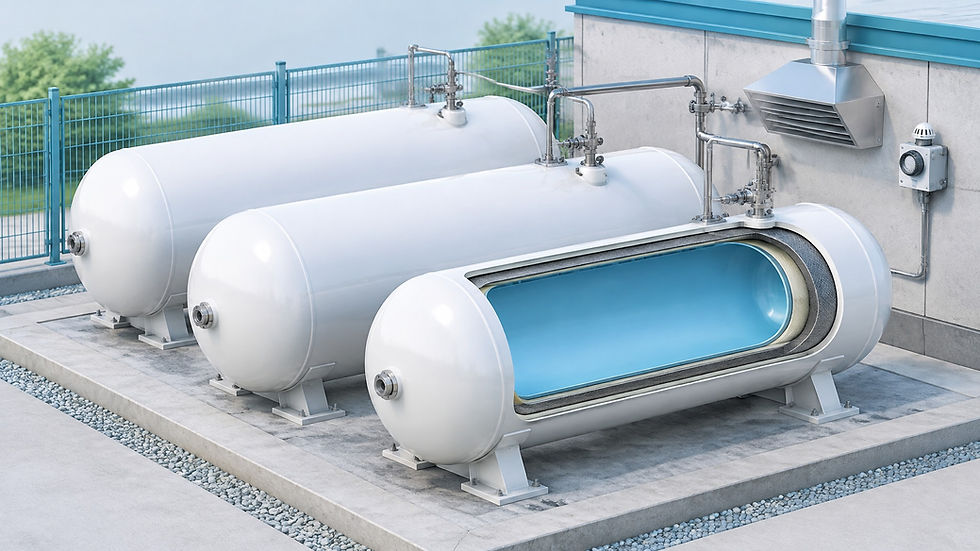
Is hydrogen safe? Yes, hydrogen can be stored, moved and used safely, but only when equipment is designed around its unusual properties: it leaks easily, ignites with very little energy and burns with a flame you can barely see. The U.S. Department of Energy puts it plainly: like most fuels, hydrogen can be handled safely "with appropriate sensing, handling, and engineering measures." [2]
This guide explains what makes hydrogen different from gasoline and natural gas, which of those differences help and which hurt, and how tanks, pipelines and stations are built to manage the risk.
Is hydrogen safe? The short answer
Hydrogen is not more dangerous than other fuels in every way, and it is not safer in every way either. It has a different risk profile. Some properties make a leak less likely to cause a fire, and others make ignition easier once a flammable mix forms. Safe design is about keeping hydrogen, air and an ignition source from meeting in the same place. [1]
Two facts work in hydrogen's favour:
It rises and spreads fast. Hydrogen is about 14 times lighter than air and rises at almost 20 metres per second, roughly six times faster than natural gas, so an outdoor leak tends to disperse quickly instead of pooling. [3]
It is non-toxic. A hydrogen release does not poison the air the way a carbon monoxide leak can. [1]
Three facts work against it:
A wide flammable range. Hydrogen can burn in air at concentrations anywhere from 4% to 75%. [4]
Very low ignition energy. Under the most favourable mix, a tiny spark is enough. [1][4]
A nearly invisible flame. In daylight, a hydrogen fire can be hard to see, so stations use special flame detectors. [1]
Hydrogen vs natural gas vs propane: the numbers
A U.S. Department of Energy comparison sheet lists these properties side by side. [4]
Property | Hydrogen | Methane (natural gas) | Propane |
Lower flammability limit in air | 4% | 5.3% | 2.2% |
Upper flammability limit in air | 75% | 15% | 9.5% |
Minimum ignition energy (stoichiometric mix) | 0.02 mJ | 0.33 mJ | 0.305 mJ |
Read the table carefully. Hydrogen's lower limit (4%) is actually close to methane's (5.3%) and higher than propane's (2.2%). What sets hydrogen apart is the top of the range and the ignition energy: at its most reactive mix it needs roughly one-sixteenth of the spark energy methane needs. DOE notes that at low concentrations near the lower limit, hydrogen's ignition energy is similar to other fuels. [3][4]
Illustrative calculation: a leak in a closed garage
Imagine a closed 50 cubic metre garage with no ventilation (an illustrative example, not a real incident). How much gas would have to leak before the air could burn?
Hydrogen: 4% of 50 m³ = 2.0 m³
Methane: 5.3% of 50 m³ = 2.65 m³
Propane: 2.2% of 50 m³ = 1.1 m³
The point is not that hydrogen is the worst of the three. It is that, indoors, hydrogen reaches a flammable mix at a similar point to other gases, and it stays flammable over a much wider range above that (up to 37.5 m³ in this room, versus 7.5 m³ for methane). That is why ventilation, ceiling-level sensors and avoiding enclosed spaces matter so much for hydrogen. Because hydrogen rises, a leak indoors collects near the ceiling first, which is where vents and detectors go. [1][3]
How hydrogen storage is kept safe
Hydrogen takes up a lot of space, so it is usually stored in one of three ways. Each has its own safety focus.
Compressed gas tanks
Most vehicles and many industrial sites store hydrogen as gas in tanks at 350 to 700 bar (about 5,000 to 10,000 psi). [5] At those pressures, the main risks are a rupture, a leaking fitting, or heat weakening the tank. DOE lists tank leak tests, garage leak simulations and tank drop tests among the testing used to show that hydrogen can be stored and dispensed safely. [1]
Liquid hydrogen
Hydrogen boils at −252.8°C at ambient pressure, so liquid storage needs heavily insulated cryogenic tanks. [5] The risks here are extreme cold (cold burns and brittle materials), and "boil-off": as heat leaks in, some liquid turns back to gas and must be vented or recovered safely.
Materials and chemical carriers
Hydrogen can also be stored inside solid materials or locked into other chemicals and released later. [5] Carriers such as ammonia or liquid organic hydrogen carriers swap hydrogen's flammability risks for the handling risks of the carrier chemical itself, which have their own rules.
Leaks, materials and detection
Hydrogen is the smallest, lightest molecule, so it slips through tiny gaps more easily than other fuel gases. Hydrogen also has no smell, colour or taste. [3] Three engineering habits follow from that:
Choose the right materials. Some metals become brittle after long exposure to hydrogen, so pipes, valves and tanks use materials tested for hydrogen service. [1] This is also why converting old gas pipelines needs careful checks.
Detect, don't sniff. Natural gas has an odorant added so people can smell leaks. Hydrogen systems rely on electronic sensors instead, and DOE's safety research focuses heavily on better leak sensors. [2]
Design out ignition sources. Equipment near hydrogen is chosen and spaced so sparks, static and hot surfaces are kept away from places a leak could collect. [1]
Codes, standards and trained responders
Hydrogen safety is not left to individual companies. In the United States, DOE requires every hydrogen project it funds to follow its safety guidelines and to be reviewed by its Hydrogen Safety Review Panel. [2] DOE also supports H2Tools, a free online hydrogen safety and emergency-response training resource for firefighters and code officials, and earlier DOE training efforts had reached more than 36,000 first responders and code officials by 2017. [2][3] Siting rules for hydrogen facilities, such as separation distances and hazardous-area zones, come from national fire codes adopted locally, so requirements depend on the jurisdiction.
Where hydrogen safety still has honest limits
Enclosed spaces are the weak spot. Hydrogen's fast dispersal helps outdoors. In tunnels, basements or sealed rooms, that advantage shrinks, so indoor use needs more ventilation and detection than many people expect.
Leaks matter for the climate too. A UK government study found that hydrogen leaking into the atmosphere has an indirect warming effect, partly offsetting the climate benefit of avoided CO₂. [6] Minimising leaks is a climate goal as well as a safety goal.
A shorter track record in homes. Hydrogen has a long industrial history, but consumer use (cars, home heating trials) is newer. DOE expects safety confidence to grow as more demonstrations build a record. [1] For many small or indoor uses, a battery or heat pump may simply be the lower-risk option.
Screening a real hydrogen project?
Safety decisions start early, with where a plant is built and how far it sits from neighbours and roads. Our H2Hub guide to green hydrogen site selection covers land, permitting and hazardous-area checks. If you are weighing a real project, Start a free project screen in H2Hub: you can start a project without an account or a card, and the first full project report is free per account.
Related reading
Sources
U.S. Department of Energy, Safe Use of Hydrogen (last updated May 27, 2026).
U.S. DOE Hydrogen Program, Safety, Codes and Standards.
U.S. DOE Fuel Cell Technologies Office, Hydrogen Safety fact sheet (DOE/EE-1557), March 2017.
U.S. DOE / NREL, A Comparison of Hydrogen and Propane Fuels, April 2009.
U.S. Department of Energy, Hydrogen Storage (last updated October 13, 2026).
UK Department for Business, Energy & Industrial Strategy, Atmospheric implications of increased hydrogen use, April 8, 2022.
Fact-checked November 18, 2026.

Comments